
For much of SEO’s history, it was simple: win.
- Win the #1 spot.
- Win the click.
- Win the traffic.
- Win the sale.
The whole industry was built around this paradigm. Businesses poured cash into content, tech SEO, backlinking, optimisation- all for the sole goal:
Win the #1 spot.
And for years, this was the right play. The #1 search result typically took the most clicks, the most eyes, the most traffic. Position 1 became the metric of success.
However, search is changing.
AI-powered search experiences have begun transforming how we find answers. AI platforms like:
- ChatGPT
- Perplexity
- Gemini
- Claude
- Google AI Overviews
And others are starting to serve up the answers before the links.
This brings up an obvious question: if we’re getting answers without a click, does Position 1 even matter anymore?
Yes and no.
Rankings still matter.
But winning now extends far beyond taking the top spot in traditional search results. The companies winning in the AI search space are often not the ones at Position 1. They’re the ones embedded in the answer.
Why Position 1 Was King
Before we get too carried away, let’s look at why the #1 position became such a coveted spot.
The process in traditional search was pretty simple:
- User searches.
- Search engine returns results.
- User clicks a result.
- Website receives traffic.
The higher up a page ranked, the more likely it was to receive a click. This relationship became a bedrock principle of SEO:
Rankings = Visibility = Traffic = Business
It was simple. If you ranked higher, you generally saw more impressions, clicks, leads, and revenue. Rankings were a straightforward proxy for discoverability.
AI Search Reorders Everything
AI-powered search fundamentally alters this paradigm. Instead of simply serving up links, AI aims to answer the question directly.
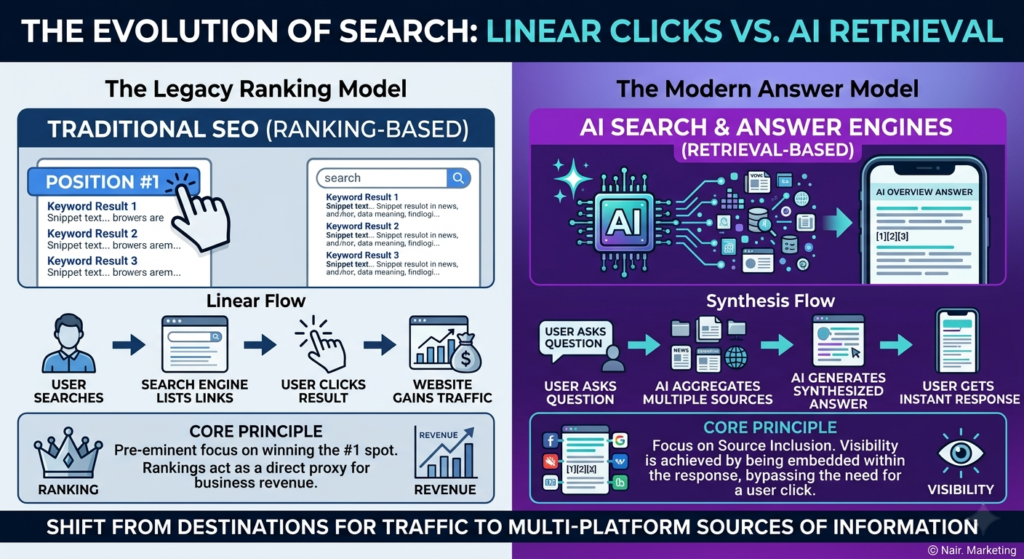
The process now often looks more like this:
- User asks a question.
- AI gathers information.
- AI generates an answer.
- User gets the answer.
The missing element here is the click. With the answer provided directly, the need to visit a website is often eliminated. This makes traditional rankings much less impactful.
Visibility in the new search paradigm isn’t about where you rank, but whether you’re part of the answer.
Position 1 Doesn’t Own the Conversation
One of the most profound changes with AI search is that Position 1 isn’t necessarily the most authoritative source in the results. AI aggregates information from a variety of places.
Take “What is lifecycle marketing?” A response could be pulled from:
- Industry publications
- SaaS companies
- Research reports
- Agency blogs
- Educational sites
The answer is a compilation of various sources, not a direct copy of one.
That means a business could be included in the answer without ranking first, or rank first and not be referenced at all.
The New Competitive Advantage: Source Inclusion
Where rankings used to define SEO success, source inclusion is now paramount.
The question shifts from:
“Where do I rank?”
to
“Am I part of the answer?”
This is a critical distinction, as users aren’t sifting through ten competing links to find what they need. They’re getting one synthesised response.
If your brand or content is included, you get visibility; if it’s excluded, you remain invisible.
Visibility Is Beyond the Search Results Page
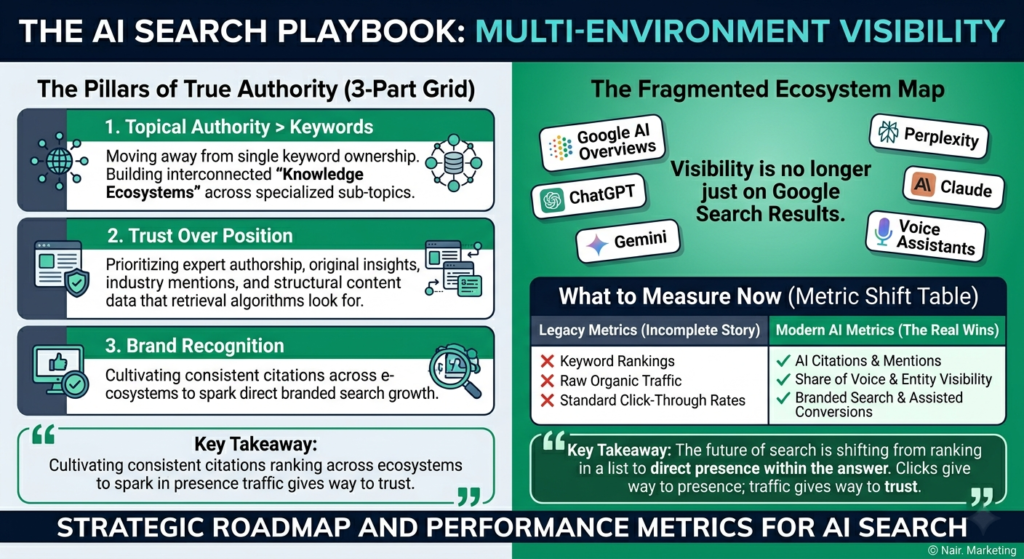
SEO used to be about mastering the Google search results page. Now, visibility is spread across a multitude of search environments:
- Google Search
- AI Overviews
- ChatGPT
- Perplexity
- Gemini
- Claude
- Voice assistants
- Domain-specific AI tools
There is no longer one “Position 1.”
Each of these surfaces has unique ways of retrieving and citing information, making a singular focus on Google rankings shortsighted.
Authority trumps Rankings
AI is inherently a trust system. Before generating an answer, it must decide which information is most reliable and which sources are most credible.
This means authority is becoming a more important signal than ever before.
The most influential elements include:
- Topical expertise
- Brand recognition
- Expert authorship
- Original research
- Industry mentions
- Consistent coverage
The AI isn’t just asking:
“Who is #1?”
It’s asking:
“Who is the most knowledgeable about this topic?”
Topical Authority Replaces Keyword Dominance
Historically, SEO revolved around keyword ownership. The formula was simple:
- Identify keyword.
- Optimise for the keyword.
- Rank for keyword.
- Repeat.
AI favours a different approach.
It rewards knowledge ecosystems.
A business publishing a single article on SEO won’t have the same impact as one consistently publishing on topics related to SEO, such as:
- Technical SEO
- Internal linking
- Core Web Vitals
- Content audits
- AEO/GEO
- Semantic search
AI sees these patterns and favours brands that demonstrate comprehensive knowledge.
Brand Recognition is its Own Ranking Signal
One of the most underestimated aspects of AI search is the growing importance of brand recognition.
As users see a brand consistently cited or referenced, they develop familiarity, which translates to:
- Trust
- Branded searches
- Better engagement
- Higher conversion rates
The Era of Retrieval-Based Visibility
Traditional SEO was ranking-based.
AI search is retrieval-based.
The goal isn’t:
“Can I rank first?”
It’s:
“Can AI systems retrieve my content?”
This requires optimising not just for search engines, but for retrieval algorithms that look at:
- Content structure
- Topic coverage
- Entity recognition
- Authority
What Businesses Need to Measure Now
Most businesses are still stuck measuring:
- Keyword rankings
- Organic traffic
- Click-through rates
These metrics still matter, but they only tell part of the story.
Progressive companies should also consider tracking:
- AI citations
- AI Overview mentions
- Brand mentions
- Share of voice
- Entity visibility
- Branded search growth
- Assisted conversions
Businesses Likely to Win
Companies that are poised for success in the AI search environment are those that:
- Produce expert-level content
- Have a strong topical authority
- Prioritise brand building
- Generate original insights
- Optimise for retrieval
- Cultivate strong entities
Most importantly, they are building authority as sources of information, not just destinations for traffic.
What the Future of Search Holds
Rankings will probably never go away entirely. Search engines need some way of organising the available information.
Rankings could evolve into one of several signals, rather than the sole metric for how well the engine is doing its job.
Visibility will continue to be split across:
- Search engines
- Answer engines
- Conversational AI
- Recommendation engines
- Digital assistants
The earliest adopters are very often the ones to gain exponential rewards for the simple reason that, while everyone else is still fighting for Position 1, they will be fighting for a prize that is infinitely more valuable;
Being a source for the answer itself.
The Take Away
Position 1 is not dead.
But its pre-eminent position as the definition of success is disappearing.
The future of search is shifting from ranking and visibility in a long list of search results to influence and the possibility of direct presence within the answer.
- Clicks will give way to presence.
- Traffic will give way to trust.
Businesses focused only on winning at Position 1 will be increasingly optimising for less than optimal digital discoverability.
The survivors of the future of search will simply recognise that winning is no longer just about being the #1 result.
It’s about being one of the sources that drives the #1 answer.
And in a world driven by AI and answer engines, that may be more valuable than Position 1 ever was.