
How Digital Performance Evolved
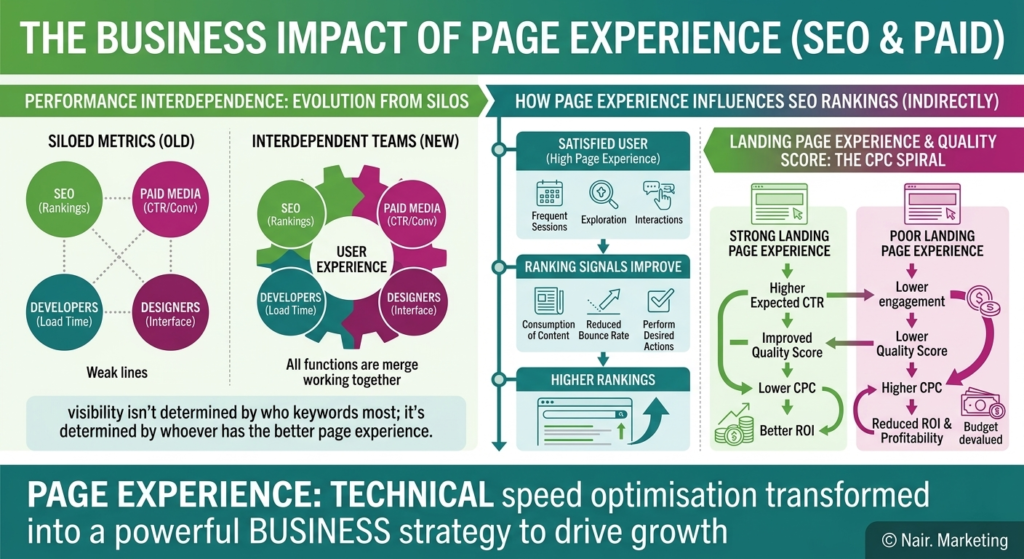
For a long time, digital performance was treated in a siloed way:
- SEO teams worried about rankings
- Paid media teams worried about CTRs and conversions
- Developers worried about load times
- Designers worried about the interface
These areas typically worked independently, optimising solely for their own metrics without regard for how they influenced other components. This is no longer the case in today’s modern digital ecosystem. Search engines, ad platforms, and users all have one main principle to drive towards: Delivering better experiences. This has fundamentally changed the way websites are perceived online. Today, visibility isn’t determined by who has the largest budget and who keywords most; visibility is determined by whoever has the better page experience.
What is Page Experience?
Page experience is the quality of the experience a user receives while browsing a web page. This is not singular, and includes:
- Loading speed
- Responsiveness
- Visual stability
- Mobile usability
- Accessibility
- Navigation efficiency
- Content usefulness
- Technical reliability
Users don’t explicitly identify and separate these values. Instead, when a user visits your web page, they form an immediate impression: “This feels easy to use” or “This feels frustrating.” This impression is typically made in seconds.
Why First Impressions are Key
User perception online relies heavily on speed and perceived effort. Studies have repeatedly confirmed that users form opinions about digital interactions immediately. Even small delays will alter your users:
- Trust
- Credibility
- Attention
- Desire to engage
- Purchase behavior
When users experience friction early on, they will immediately think that:
- The business is unreliable
- The information cannot be found easily
- The web page is not professional
- I’ll need to try too hard to achieve my task
Without even interacting with the web page, they have already assumed your brand.
Understanding Page Speed in More Than Just Load Times
While speed often boils down to how fast a web page loads, this definition is no longer enough in today’s web, as users rely on the overall experience. For example, a web page may load in just 3 seconds; however, this doesn’t mean users won’t get the experience of seeing:
- A slow-moving form
- A delayed button response
- A content jump when an element appears
- A blocking interaction
Although the page technically loads fast, it does not feel fast. This distinction creates a difference between load speed and perceived page speed.
The Psychology of Waiting
Waiting breeds uncertainty, uncertainty breeds friction, and friction breeds abandonment. Even an exceptionally small delay will change user behaviour as they are wired to reduce effort where possible.
Examples of what lead to user friction:
- Delayed forms responses
- Slow menu interaction
- Late loading images
- Interrupted content presentation
Each additional step, each additional obstacle creates increased cognitive effort, reducing your user’s satisfaction, engagement, and their likelihood to convert.
Introducing the Core Web Vitals
The Core Web Vitals were designed by Google to measure the experience of users on real-world web pages. The Core Web Vitals take a different approach to how websites are perceived, stepping away from only technical measurements and more towards practical interaction quality.
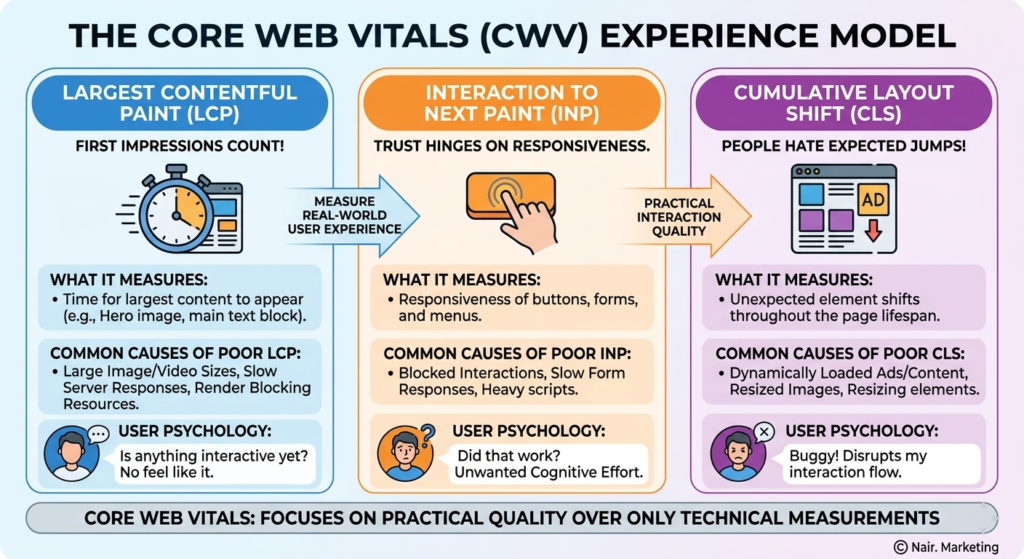
Largest Contentful Paint (LCP)
First impressions count! LCP measures how quickly the largest content on the web page appears to the user. Users want to see something engaging as soon as possible, so they don’t feel like nothing is going on on your page. This metric often suffers due to:
- Large image sizes
- Heavy scripts
- Slow server response time
- Render blocking resources
- Unoptimized video
A weak LCP indicates the user does not feel like there is anything interactive for them.
Interaction to Next Paint (INP)
Trust hinges on responsiveness. The INP measures how quickly your page responds to the user’s interaction with the page, whether this is with a button click, a form completion, or a new menu option. This metric often suffers due to:
- Slow interactions with buttons, form fields or menu elements
When your website fails to deliver responsive interaction, the user becomes confused:
- “Did that work?”
- “Do I need to press it again?”
Such issues will lead to frustration and an unwanted increase in Cognitive Effort.
Cumulative Layout Shift (CLS)
People hate it when things unexpectedly jump around! The CLS measures how much elements on the web page shift throughout the page’s life span. Things like dynamically loaded ads, resized images, or content shifts create unwanted visual hiccups. Such ‘blinks’ disrupt the flow of interaction with your page. When a user cannot reliably interact with elements on the page, they will often assume your website is buggy.
Page Experience and SEO: What’s the Connection?
Search engines are becoming more aware of the user experience, taking factors other than content and link profile into account, in addition to these metrics. Your bounce rate, session duration, scrolling depth, return visits, and engagement rate will all impact your search engine visibility.
A high page experience will:
- Promote more frequent sessions
- Increase the user’s desire to explore the page
- Improve the number of interactions on the page
- Increase the chances of conversion
Why is this indirectly a ranking signal? It’s simple-when your user is satisfied, they consume more of your content, are less likely to bounce, and are more likely to perform desired actions on your page. All these factors will lead to higher rankings.
Quality Score and Page Experience: The Cost Inflation Effect
The general assumption when talking about the benefits of a strong paid campaign is often the Quality Score. While bids and ad copies are still a priority for paid campaigns, the page experience of the landing page itself plays a significant role. This metric accounts for expected CTR, ad relevance and landing page experience.
Poor page experience creates a spiral that can devalue your budget:
- Low engagement
- Lower Quality Score
- Higher CPC
- Eventually, decreased profitability and scalability
Many businesses believe the solution is to buy better traffic at a higher cost, when in reality, all that you need is a better page experience to draw in the user. Competitors with strong page experiences will continue to attract users with lower CPC, and see improved rankings and conversion rates.
Why is the Mobile experience so important?
With 80% of internet usage being mobile-driven, the emphasis on a strong mobile web page is more important than ever before. While users have fewer attentional resources and are often more easily distracted when browsing on mobile, the response time expectations remain higher than for other devices.
A small performance improvement can increase engagement, form completion, and conversion rates while decreasing those statistics. Google’s mobile-first indexing further highlights the need to focus on a mobile page experience.
Page experience is now a revenue generator.
Page speed optimisation, which used to be considered a solely technical issue, has turned into a growth driver that influences many business decisions.
Optimising the page experience will benefit:
- SEO visibility
- Quality score
- Customer acquisition cost
- Conversion rate
- Lead quality
- Customer retention
- Customer satisfaction
Technical page speed optimisation has transformed into a powerful business strategy.
Conclusion
Page speed, Core Web Vitals and Quality Score should be viewed as interdependent metrics working together to achieve an enhanced page experience. This will continue to be prioritised more heavily by both search engines and ad platforms. While visibility attracts users, it is the experience that will engage them and drive them to convert.