Why Ranking Content Is No Longer as Simple
Once, ranking content was relatively easy. You picked a keyword. You optimized a page for it. You built some backlinks. You wait for Google. If you did it well, it often worked. Not anymore. The modern search landscape has dramatically moved beyond simple keywords and single-page evaluations. Today, Google (and other search engines) are increasingly trying to understand:
- Context
- Meaning
- Intent
- Topic associations
- User intent
- Entity connections
- Information quality
- Subject expertise
This has had a profound impact on how websites are recognized for their visibility. Websites are no longer simply recognized for mentioning keywords, but for demonstrating expertise within entire topic areas. This is where topical authority comes in. It’s one of the strongest long-term drivers of sustainable organic growth because it signals that a website understands not just an individual page, but an entire subject area. Businesses stuck in the old paradigm of isolated keyword targets are often struggling to scale. Those building broader contextual understanding tend to create much stronger long-term visibility.
What is Topical Authority?
Topical Authority is essentially how comprehensively a website covers a particular topic. Rather than considering individual pages in isolation, search engines view the collective work of a website as a holistic body of knowledge. Creating one article about SEO does not grant you SEO authority. But publishing articles across topics such as:
- Technical SEO
- On-page SEO
- Keyword research
- Internal linking
- crawl budget
- Semantic search
- Page experience
- Content strategy
- Page Speed (CWV)
- Structured data
- Entity optimization
will eventually contribute to establishing broader topic authority. In many ways, Topical Authority moves beyond content pieces and becomes about demonstrated understanding of entire subjects.
Why Search Engines Needed Topical Authority
The easiest way to understand topical authority is to look at the problem that Google was trying to solve: how to distinguish genuinely knowledgeable and authoritative websites from spammy ones that just gamed the keyword stuffing and backlinking game. In earlier times, search engines had a fairly simple equation: match the keywords in the query to the content, then count the backlinks to the page. This was easy to game by, for example, creating dozens of pages that all just repeated the same set of keywords. A site might optimize for “Best Running Shoes”, “Affordable Running Shoes”, “Running Shoe Recommendations”, etc., even if the pages provided virtually no new information. So, how do you make sure someone has real knowledge of a topic, not just an ability to stuff the same keywords? Mentioning “supply chain management” 20 times on a page doesn’t mean the author knows anything about: logistics planning, inventory management, freight management, warehouse operations, or demand forecasting. This was the problem. Search engines needed to begin assessing context and understanding.
The Evolution of Search
To truly appreciate Topical Authority, you have to understand the evolution of search over time:
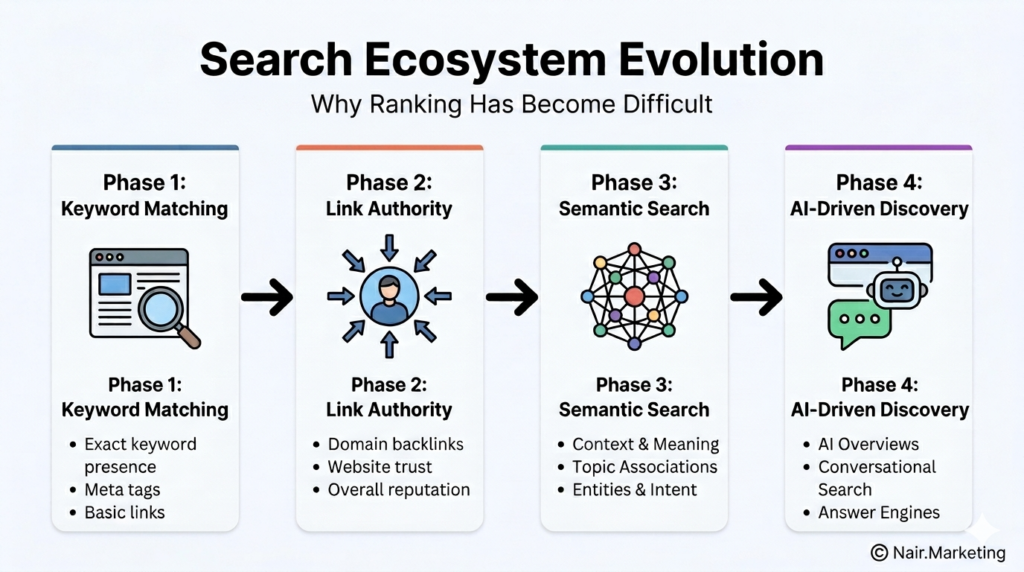
1. Keyword Matching
The first generation of search engines focused on exact matches and keyword density.
2. Link Authority
The second generation focused on backlinks, measuring how many external sites trust that page. This was a major leap, but not a perfect one, as authority can still be bought or generated without expertise.
3. Semantic Search
Modern search begins with semantics, understanding the meaning of queries and topics. It’s not about keywords, but about intent and context. Google now uses machine learning to understand topic relationships, intent, and how to extract relevant information even if a user hasn’t used the exact words.
4. AI-Powered Search
Search is rapidly becoming more advanced and user-focused. Think about Google’s AI Overviews, and search being integrated into conversational agents and AI assistants. This demands a much higher level of contextual understanding, and AI models will favor sources with established topical expertise.
Topical Authority vs. Keyword Targeting
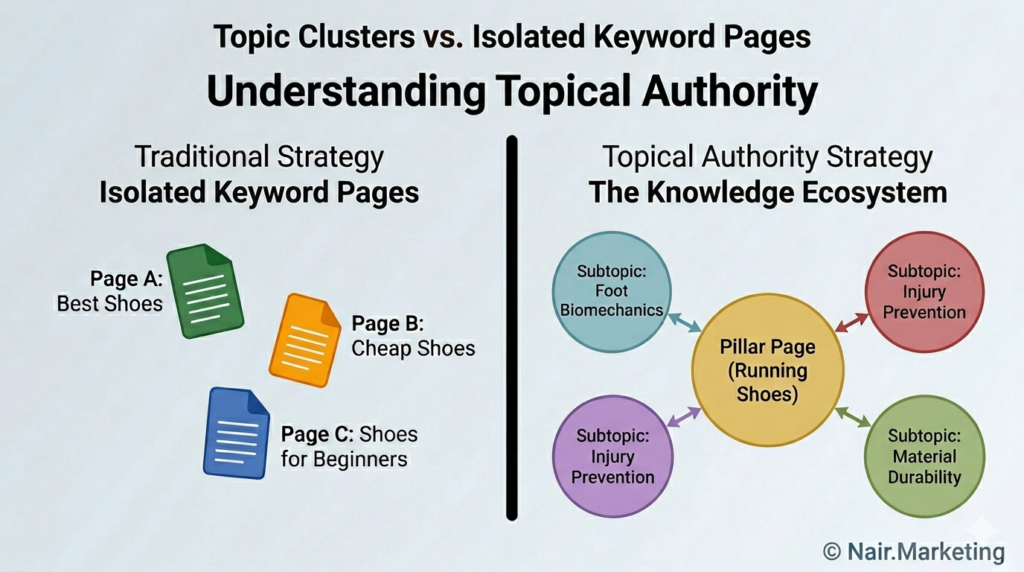
One of the biggest misconceptions is that Topical Authority simply means covering more keywords. This is a common confusion with the more traditional keyword targeting approach which involves building separate pages around specific keyword variations like:
- Page A: “Best Running Shoes”
- Page B: “Running Shoes for Beginners”
- Page C: “Cheap Running Shoes”
Topical authority operates differently by asking, “What’s the knowledge ecosystem around running shoes?” This encompasses:
- Running styles
- Foot biomechanics
- Training routines
- Injury prevention
- Shoe materials
- Terrain types
- Shoe maintenance
- Performance comparison
The focus shifts from accumulating keyword rankings to claiming knowledge of an entire subject.
Topical Authority vs. Domain Authority
Another area where people get confused is confusing Topical Authority and Domain Authority. While related, they measure fundamentally different things. Domain Authority (DA) reflects a site’s overall strength and trust as measured by backlink signals, history and website reputation. Topical Authority, however, measures depth within a specific topic area. A large news site might have high DA, but low topical authority in technical SEO, whereas a small industry blog might have low DA but extremely high topical authority in their niche. This is why the little guys sometimes win.
Understanding Topic Clusters
The underlying structure that fuels topical authority is the topic cluster. This system typically involves:
Pillar Content
A comprehensive overview of a broad topic (e.g., “Ultimate Guide to On-Page SEO”).
Supporting Content
More focused pieces that cover subtopics within the pillar (e.g., “What Are Internal Links?”, “How to Optimize Titles and Meta Descriptions”).
Internal Connections
Both pillar and supporting content pages are linked back and forth to create a cohesive topic ecosystem. This interconnected structure demonstrates your website’s depth and comprehensive coverage of a given topic, giving search engines the signals they need to understand your expertise.
Content Breadth vs. Depth
For true topical authority, a balance of breadth and depth is essential. Content breadth refers to the scope of the topic ecosystem your website covers, while depth refers to how comprehensively you cover each individual subtopic. Without enough depth, you risk having shallow content that only grazes the surface of a topic. Without enough breadth, you miss crucial contextual elements and broader user intents.
Why Internal Linking is Essential
Internal linking is a powerful tool that acts as an authority distribution mechanism. A well-structured internal linking strategy helps search engines understand the relationships between your content, the hierarchy of your topics, the depth of your expertise, and the overall context of your information. Without it, each piece of content would be an isolated island, failing to communicate a coherent picture of your expertise.
Understanding Entities and their Relation to Topical Authority
Entities are essentially things that the search engine can identify, understand, and relate to. Examples of entities include “Google,” “SEO,” “Core Web Vitals,” “Logistics.” Search engines are getting better at understanding the relationships between these entities, and as your website demonstrates strong expertise in how entities relate to each other, your overall contextual understanding increases.
The Role of E-E-A-T and Topical Authority
Google’s EEAT framework (Experience, Expertise, Authoritativeness, Trustworthiness) directly supports and is boosted by topical authority. Providing “experience-based” explanations (as opposed to just generic, information-gathering ones) can lead to stronger authority signals, particularly in niche areas.
User Journeys Drive Topical Authority
People rarely interact with pages individually.
Scenario:
User searched:
What is freight forwarding?
User then searches:
How freight forwarding works
User then searches:
Freight forwarding vs logistics management
User then searches:
Freight forwarding company near me
Strong topical ecosystems enable:
- Awareness
- Consideration
- Comparison
- Purchase intent
Why Topical Authority Matters in AI Search
- Comprehensive information
- Organized structure
- Conceptual understanding
- Signals of trust
- Relationships between entities
AI systems will favor and rely on content with higher demonstrated subject matter authority.
Common pitfalls when building Topical Authority
- Creating a mess of scattered content without structure
- Publishing to satisfy quantity, not quality and context
- Failing to link topics together
- Chasing all high-volume keywords possible
The Practical Framework for Building Topical Authority
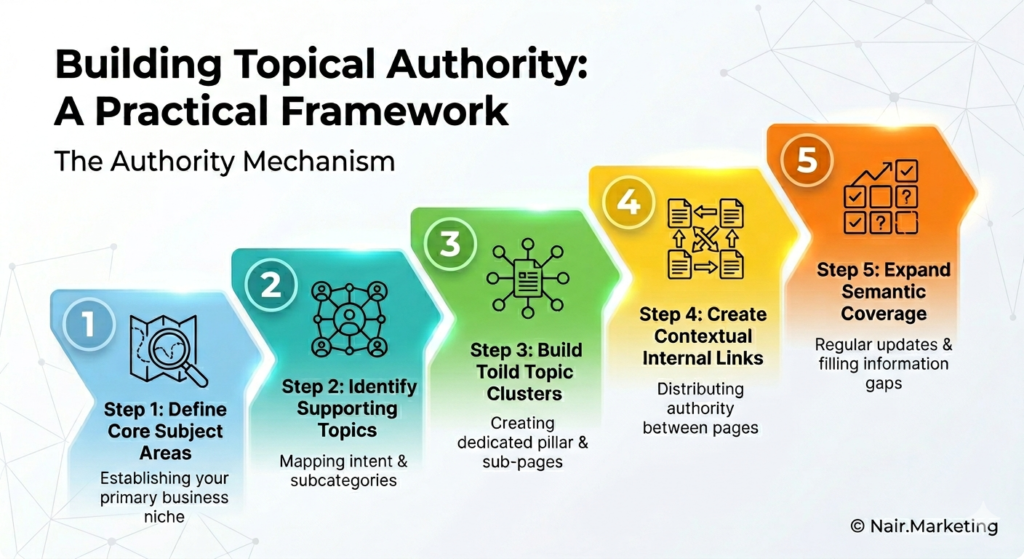
1. Define your core subject areas.
2. Identify and flesh out your supporting topics.
3. Create your topic clusters.
4. Interlink between topics contextually.
5. Expand semantic coverage on topic clusters.
How to measure Topical Authority
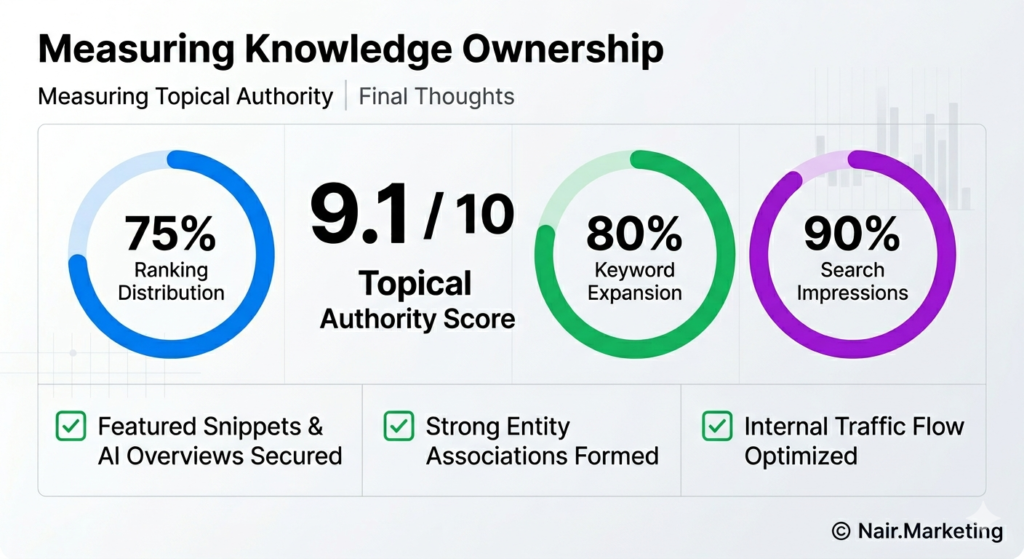
To Measure Topical Authority, you need to Look at:
- Your keyword rankings spread
- The number of new keywords that cluster around your topic
- The amount of internal traffic that flows between topics
- Search impressions
- Featured snippets
- Entity associations
The Wrap-Up
Building Topical Authority is becoming less about the act of publishing content and more about constructing knowledge bases.
Search engines are shifting towards
Who proves the deepest understanding?
Instead of:
Who has produced the most pages?
Businesses that construct their interlinked knowledge ecosystems will often be able to create greater, more sustained visibility for their brands.
Because SEO is moving from the concept of “keyword ownership” toward “subject ownership”
And subject ownership breeds authority.