Introduction
One of the biggest misconceptions about AI search is that once you’re ranking #1 for important queries in Google, your brand will automatically get cited in ChatGPT, Perplexity, Claude, Gemini and all other AI search engines and answer generation platforms.
Nothing could be further from the truth.
While rankings can certainly help, simply having high Google rankings does not guarantee your content will be included in AI-generated search answers.
As a matter of fact, a lot of businesses are seeing a strange phenomenon: ranking on the first page of Google for important queries, and never being referenced in AI answers.
In the meantime, other companies with smaller sites and much less traditional organic reach appear frequently in the AI search landscape.
Why?
Because AI search does not evaluate search engines and websites like traditional Google search does. Modern answer engines (ChatGPT, Perplexity, etc.) rely on collecting, summarising, and generating responses based on many trustworthy sources.
They aren’t simply looking for the single best result.
They’re trying to extract the best, most useful, and most relevant information on a given topic from wherever they can find it.
This dramatically changes the optimisation game.
It’s no longer a question of:
“How can I rank #1?”
The question becomes:
“How can I become a source that AI models deem trustworthy and cite in their answers?”
Here’s what you need to know and do.
How AI Citation Works before You Begin Optimising
As with any new field, a fundamental understanding goes a long way.
The basic process an answer engine uses typically follows:
- User query comes in
- Information retrieval process (AI scours the web)
- Source evaluation (AI assesses the trustworthiness, relevance, etc., of found content)
- Response generation and citation
In essence, a core prerequisite for a brand getting cited in an AI answer is the AI actually discovering your content first.
If the AI cannot find, understand, or trust your content, even the best-written piece will likely never get referenced in its answers.
As you can see from the basic outline, a citation opportunity depends on more than just one individual piece of content and how it ranks.
It depends on many factors, including:
- Information accessibility
- Content quality
- Authority on the topic
- Source trust
- Brand recognition
- Entity associations
Many businesses today focus purely on SEO and rankings, neglecting other crucial signals.
Why Rankings are no Longer Enough
Back in the early days of search, rankings were everything.
Get ranked #1 and your website gets the click.
Your click turns into a lead or sale.
Today, especially with AI, information is retrieved differently.
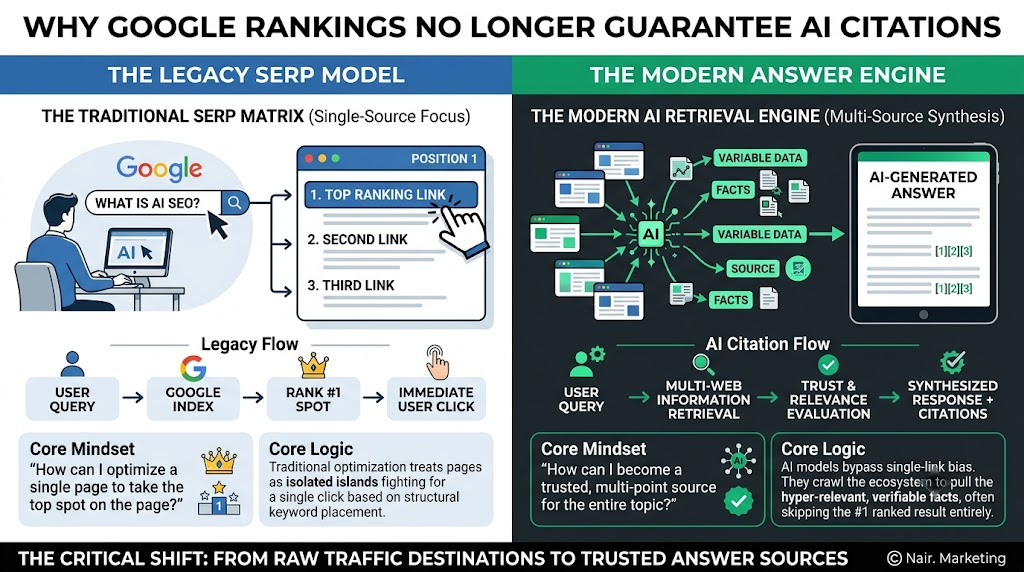
Rather than just pulling the highest ranking URL, AI engines often retrieve relevant pieces of information from several sources and synthesise an answer.
For instance, if someone searches for “freight forwarding companies,” a typical AI answer might aggregate information from industry websites, government resources, and logistics-focused blogs.
Even if your content isn’t the highest ranking result for that query, your data can still be used in the answer if your authority on the subject is strong enough.
Build Topical Authority
Topically speaking, AI search is increasingly looking for consistency in the information and expertise a site provides.
Instead of simply finding a strong single piece of content, AI is looking for:
“Who are the dominant authoritative voices on this topic?”
A single blog post about SEO will rarely make a significant impact on AI visibility.
But a collection of comprehensive resources on SEO topics – covering:
- Internal linking
- Core Web Vitals
- Keyword research
- Structured data
- AEO
- GEO
etc. – builds a strong case of your brand being the go-to resource.
The stronger and broader your topical coverage, the better.
Topic coverage is directly linked to Brand Entity strength.
Become a Brand Entity, not Just a Website
AI has started to rely heavily on entities, which represent concepts, products, companies, or people, to organise information.
The more that an entity is connected to relevant topics, the stronger it becomes as an information source.
A business needs to develop clear, consistent links between:
- Its brand name
- Topics and subjects it covers
A brand entity can be defined as:
- Nair Marketing
- SEO
- AEO
- GEO
- Paid Advertising
- Lifecycle Marketing
- Analytics
Each mention and consistent link will enhance the overall entity.
Publish Unique Insights
One of the fastest ways to get an AI citation is to publish information that isn’t available elsewhere.
Most sites just repeat what already exists.
AI already has access to thousands of articles repeating the same advice.
Examples include:
- Industry studies
- Original research
- Survey data
- Benchmarking reports
- Case studies
- Performance data
- Proprietary frameworks
If 50 different sources provide the same generic advice, AI won’t be motivated to cite any one in particular.
But the source providing unique insight will stand out.
Use Structured Content
The way your information is structured makes a huge difference for retrieval systems.
AI can better process easily extractable information, which looks like this:
- Clear headings and subheadings
- Logical hierarchy
- Direct answers
- Bullet points and numbered lists
- Tables and charts
- Definitions and FAQs
For example, answering a direct question like:
“What is GEO?”
A short, direct answer is easier for AI retrieval systems than burying it in a dense paragraph.
You want to make information easily understandable for AI.
For instance:
“Generative Engine Optimisation (GEO) is the process of optimising content and digital assets to improve visibility within AI-generated search experiences.”
Author and Brand Trust Signal
Signals from authors are becoming very important for AI.
This doesn’t mean that only authors from major publications can get citations.
Any signals that contribute to perceived authority will help.
These may include:
- Relevant professional experience
- Well-written author bio
- Industry thought leadership
- Speaking experience
- Public publications
- Public profiles
If you’re a consultant or expert in your field, this is likely going to be through personal brand building.
The stronger the people on your team are as individual entities, the easier it will be for their combined information to form a strong company entity.
Earn Mentions Everywhere
While backlinks are still valuable, mentions are increasingly being used as a sign of authority.
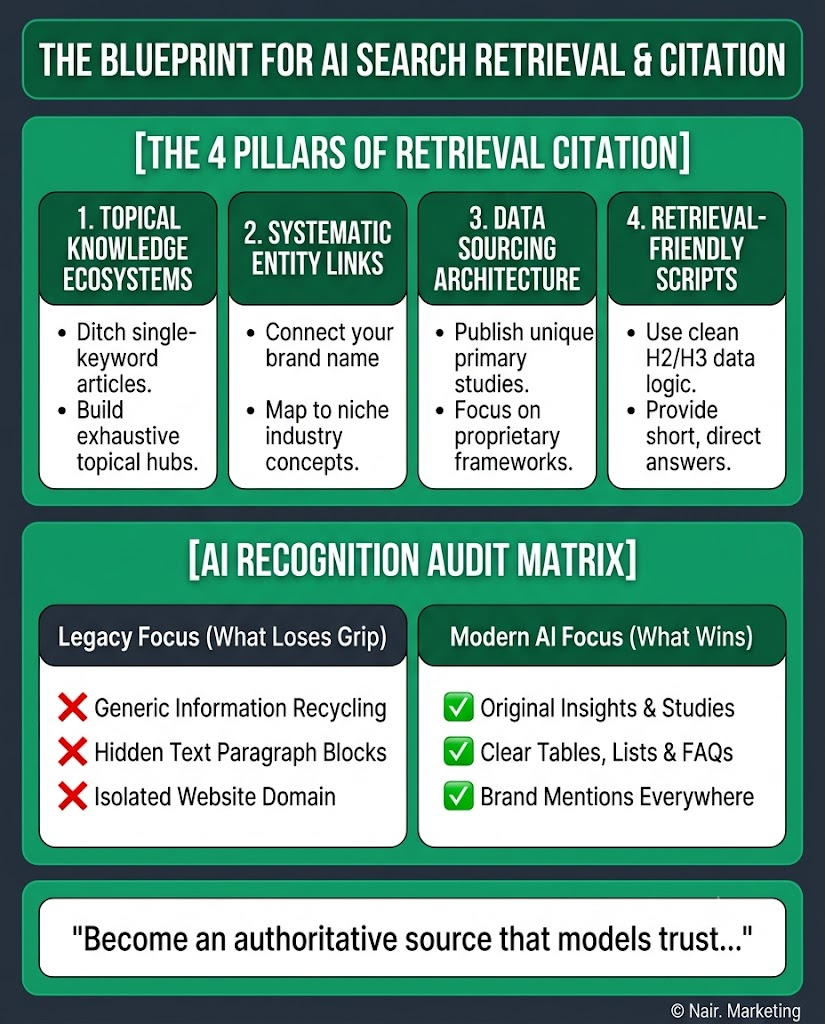
AI is essentially looking at who is talking about your brand.
This includes:
- Industry news sites
- Other reputable blogs
- Podcasts
Conclusion
For a long time, to be found and cited across search engine result pages (SERPs), brands needed to be found and cited on search engine result pages (SERPs). When that time comes for AI-powered search, businesses that produce authority and own authentic insight and are optimising for retrieval, not just ranking, are going to be cited the most across experiences with AI in the driver’s seat.