
One of the biggest misconceptions when it comes to digital advertising is that bidding simply means: “Whoever bids the most, wins.” It’s rarely that simple in practice. After running ads on both Google and Meta, I quickly realised that simply raising bids hardly ever resolves performance issues. I’ve seen numerous advertisers pump budgets into campaigns hoping to see quick gains, only to end up spending more and watching performance stagnate.
Why is this? Both Google and Meta are tackling a problem far greater than simply finding someone to pay for ad space. They aim to create value for three parties: the advertiser, the user, and the platform itself. If users have bad experiences, they’ll stop engaging, which decreases advertiser spending and eventually weakens the ecosystem. That’s why modern ad auctions have evolved far beyond a simple price-based competition. Both platforms use machine learning, behavioural predictions, quality signals, and contextual analysis to determine who gets an ad impression.
On the surface, both platforms look quite similar-they both involve budgets, bids, and audiences. However, they operate very differently. Google taps into existing demand. Meta generates and influences it. Google responds to user intent. Meta predicts user behaviour. Realising this distinction can completely change how campaigns should be built from the ground up.
How Bidding Works on Google Ads
Google’s Intent-Based Ecosystem
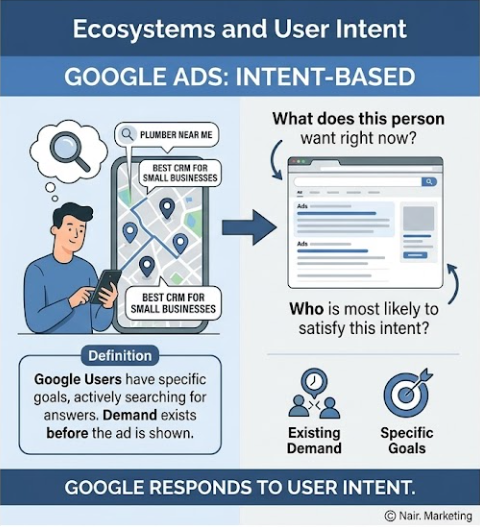
Google users often arrive with a specific goal in mind. They’re trying to solve a problem, find answers, get information, or are actively searching. Think “plumber near me,” “freight forwarding in Bangalore,” “best CRM for small businesses,” or “running shoes under $100.” The key difference here is intent-the demand exists before the ad is shown. Google doesn’t need to convince users to care about a problem; they already do. Google just needs to figure out “Who is most likely to satisfy this intent?” This subtle difference has a significant impact on the entire bidding system.
Understanding Google’s Ad Rank System
It’s a common mistake to believe that the highest bid always gets the top position. In reality, campaign performance often tells a different story. Let’s say Advertiser A bids $15 per click but has weak ad relevance, a generic landing page, and low click-through rates. Advertiser B, on the other hand, bids $10 per click but has highly relevant ads, a dedicated landing page, and a strong engagement history. While many might assume Advertiser A wins, it’s often Advertiser B who appears higher.
This is because Google considers far more than just the bid amount. It tries to predict “Which advertiser will provide the best experience for the user?” Ad Rank is calculated based on several factors:
Bid Amount
How much are you willing to pay?
Quality Score
This typically takes into account expected click-through rates, ad relevance, and landing page experience.
Auction-Time Signals
Google also considers factors such as the type of device, user location, search context, time of day, user behaviour, search intent, and the intensity of competition.
The practical implication of this is crucial: In many cases, improving your Quality Score will bring down your cost per acquisition more effectively than simply increasing your bids.
Google Ads: Ad Rank
Ad Rank = Bid×Quality Score×Expected Impact of Ad Extensions×Auction-time Signals
In practice, Google doesn’t publish a single multiplied formula. Ad Rank is a composite score calculated at every auction using these factors:
| Factor | What it means |
| Max CPC Bid | The ceiling you’re willing to pay per click |
| Quality Score (1-10) | Composite of Expected CTR + Ad Relevance + Landing Page Experience |
| Expected impact of extensions | Sitelinks, callouts, structured snippets — estimated uplift |
| Auction-time context | Device, location, time of day, search query, competitor landscape |
| Ad format | Whether your format suits the context |
Quality Score breakdown:
Quality Score = f(Expected CTR, Ad Relevance, Landing Page Experience)
Each sub-component is rated Below Average / Average / Above Average.
CPC you actually pay:
Actual CPC = Ad Rank of competitor below you/Your Quality Score+$0.01
This is why a higher Quality Score lowers your actual cost even at the same position.
How Bidding Works on Meta Ads
Meta’s Discovery-Based Ecosystem
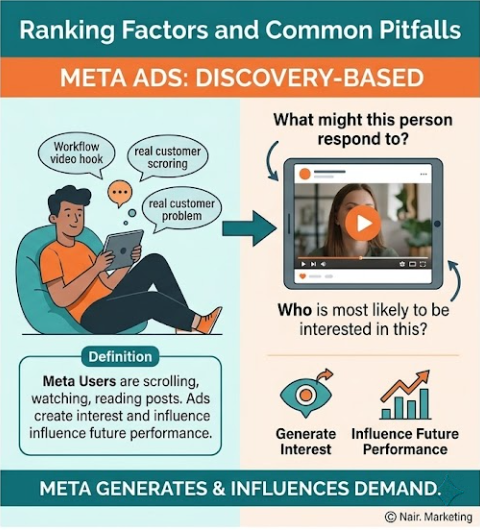
Meta operates in a very different way. Users on Meta are typically not searching for solutions; they are scrolling, watching content, reading posts, and interacting socially. Users on Meta rarely say, “I need this product right now.” Instead, Meta’s question is “Who is most likely to be interested in this?” This distinction has huge implications for campaign optimisation.
For example, a Google user searching for “best project management software for agencies” has a clear demand. A Meta user, however, might be scrolling through their feed when “that workflow video catches my eye,” even if they weren’t actively looking for project management software. One shows existing demand; the other creates interest. This fundamental difference significantly impacts bidding strategies.
Why Creative Performance Matters More in Meta Ads
One of the most frequent patterns I observe in Meta campaigns is advertisers trying to solve performance issues solely through audience targeting. More often than not, the bigger problem is creative fatigue. Consider these two campaigns:
Campaign A
Strong audience targeting, but weak static creative, generic messaging.
Campaign B
Moderate audience targeting, but a short video showing a real customer problem with clear messaging and a strong hook in the first three seconds.
Campaign B often outperforms Campaign A. This is because Meta heavily rewards engagement behaviours. When a user stops scrolling, watches a video, or interacts with an ad, it signals positive interest to Meta’s algorithm, which interprets these actions as indicators of future performance. This is why creative refresh cycles in Meta ads tend to have a much greater impact than changes to bids.
Meta Ads: Total Value Score
Total Value = Advertiser Bid×Estimated Action Rate+User Value
Meta’s auction is a second-price auction where the winner isn’t just the highest bidder, but it’s whoever delivers the most total value to the user.
| Factor | What it means |
| Advertiser Bid | Your manual bid, or Meta’s estimated bid if using Advantage+ / lowest cost |
| Estimated Action Rate (EAR) | Predicted probability the specific user takes your desired action (click, purchase, lead) — Meta’s ML model |
| User Value | Meta’s assessment of ad quality — relevance, engagement signals, low negative feedback, post-click experience |
Ad Quality sub-signals under User Value:
- Engagement rate (likes, shares, saves, comments)
- Negative feedback rate (hide ad, report ad)
- Landing page quality
- Avoiding “engagement bait” or low-quality creative
The Practical Differences Between Google and Meta
When running campaigns across both platforms, a clear pattern emerges:
Google performance issues often stem from:
- Weak keyword intent
- Poor landing pages
- Low Quality Scores
- Incorrect campaign structure
Meta performance issues often stem from:
- Creative fatigue
- Weak hooks
- Messaging problems
- Audience saturation
- Poor conversion signals
Many businesses mistakenly apply their Google advertising strategies to Meta, or vice versa, hoping to achieve the same results. However, the platforms are trying to solve fundamentally different behavioural problems.
Google asks:
“What does this person want right now?”
Meta asks:
“What might this person respond to?”
This core difference influences almost every aspect of campaign management-from structure and creative strategy to budget allocation, optimisation, and attribution. Understanding this distinction is often far more valuable than simply increasing your bids.